Here's the problem with most "best skin tag removal pen" lists: they either recommend whatever has the highest Amazon rating (regardless of whether the device is actually any good), or they're written by someone who's never held one of these pens in their life.
So let's do this differently.
This guide is based on what actually matters when you're holding a skin tag removal pen in your hand — power control, tip quality, safety certifications, and whether the thing will actually remove your skin tag without leaving a scar. We'll cover what separates a quality pen from a waste of $20, then give you specific picks based on what you need.
What Makes a Skin Tag Removal Pen Actually Good? 7 Features That Matter
Before we get to picks, let's establish what you should actually be looking for. Most buyers focus on the wrong things — price and star rating — while ignoring the features that determine whether your skin heals clean or scars.
1. Adjustable Power Levels (Non-Negotiable)
A skin tag removal pen with only one power setting is like a stove with only "maximum heat." Different skin tags — different sizes, different locations, different skin types — require different energy levels.
What to look for:
- Minimum 5 levels, ideally 9 — gives you fine control
- Levels should produce a visibly different output — if levels 3 through 7 all feel identical, the control is fake
- The ability to start low and increase gradually is what prevents burns and scars
Why it matters: A 1mm skin tag on your neck needs far less energy than a 4mm tag on your back. Without adjustable power, you're either undertreating (tag doesn't fall off) or overtreating (scar). There is no middle ground.
2. Fine, Precision Tip
The tip is the entire interface between the device and your skin. If it's blunt, wide, or poorly machined, you're spreading energy over a larger area than necessary — which means more damage to healthy skin.
What to look for:
- Needle-fine tip — the smaller the contact point, the more precise the treatment
- Replaceable or interchangeable tips — tips wear down over time; a pen that lets you swap tips lasts years instead of months
- Smooth, burr-free finish — a rough tip tears skin instead of vaporizing it cleanly
3. Safety Certifications (CE, RoHS, FCC)
A skin tag removal pen is an electrical device that creates a plasma arc on your skin. If that sentence makes you want some assurance that the device won't short-circuit or deliver inconsistent power — good instinct.
What to look for:
- CE certification — meets EU electrical safety and health standards
- RoHS — restricts hazardous substances in the device's components
- FCC — tested for electromagnetic interference (won't disrupt other electronics)
4. Clear, Readable Display
You're going to be staring at this thing while holding it millimeters from your skin. If you can't clearly see what power level you're on, you're guessing — and guessing leads to mistakes.
What to look for:
- LED or LCD display showing the current power level
- Display should be visible from your treatment angle — not hidden on the side you can't see
- Bright enough to read in a well-lit bathroom
5. Comfortable, Non-Slip Grip
You're doing precision work on your own skin. If the pen is slippery or awkward to hold, your hand will shake — and a shaking hand means the tip wanders off the skin tag onto healthy skin.
What to look for:
- Textured or rubberized grip area — not smooth plastic
- Lightweight but not flimsy — 50-100g is the sweet spot
- Pen-like form factor — you're holding it like a pen, so it should feel like one
6. USB Rechargeable (Not Disposable Batteries)
Disposable battery pens are a false economy. The battery dies mid-treatment, you don't have spares, and the power output drops as the battery drains — meaning inconsistent results.
What to look for:
- Built-in rechargeable battery via USB-C or Micro-USB
- Overcharge protection — prevents battery damage if left plugged in
- Decent battery life — should handle multiple treatment sessions on a single charge
7. Sterilizable or Replaceable Tip
You're creating micro-wounds on your skin. The tip needs to be clean — every single time. A pen with a fixed, non-removable tip that you can't properly sterilize is a infection waiting to happen.
What to look for:
- Removable tip that can be cleaned with alcohol
- Or disposable tip cartridges that you replace between uses
- At minimum, a tip material that can withstand alcohol sterilization without degrading
Plasma Pen vs. Freezing Pen: Which Technology Should You Buy?
Before picking a specific device, you need to pick a technology. Here's the honest comparison:
| Factor | Plasma Pen | Freezing Pen (Cryo) |
| How it works | Creates a tiny electrical arc that vaporizes skin tag tissue | Super-cools the tip to freeze and destroy tag cells |
| Speed of results | Scab forms day 1-2, tag falls off day 5-10 | Blister forms day 2-4, tag falls off day 7-14 |
| Pain level | 1-2/10 (quick pinprick) | 0-1/10 (cold numbness) |
| Best for | Raised, protruding skin tags; moles; warts | Flat or small skin tags; sensitive skin |
| Precision | Extremely precise — pin-point targeting | Less precise — cold spreads to surrounding tissue |
| Scarring risk | Low (with proper use) | Very low (gentler process) |
| Learning curve | Moderate — takes 1-2 uses to get comfortable | Easy — straightforward application |
| Price range | 80 | 100 |
| Re-treatment rate | 10-15% | 15-25% |
Our recommendation: For most people, a plasma pen is the better choice. It's faster, more precise, and works on a wider variety of skin tags. The freezing pen is a good option if you have very sensitive skin or are particularly nervous about pain — but expect a longer healing timeline and a slightly higher chance of needing a second treatment.
Best Skin Tag Removal Pen: Our Top Picks for 2026
Best Overall: MYCHWAY Painless Mole & Skin Tag Removal Pen (OT-AC019G)
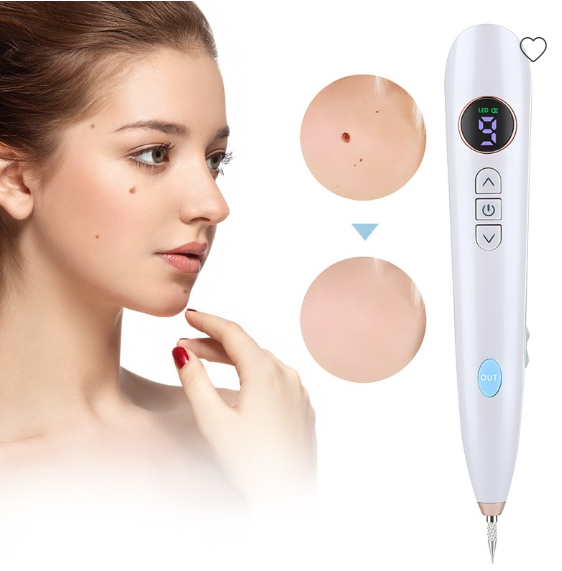
Price: $25.99
This is the sweet spot — professional-grade features at a consumer-friendly price, from a manufacturer that actually makes beauty equipment (not a random dropshipper rebranding Alibaba stock).
Key specs:
- 9 adjustable power levels — the most granular control in its price class
- Precision fine tip — targets skin tags, moles, freckles, and age spots without affecting surrounding skin
- LED display — clearly shows your current power setting at a glance
- USB rechargeable — built-in battery with overcharge protection
- Non-slip ergonomic grip — pen-like form factor for steady, controlled application
- CE, RoHS, FCC certified — meets international safety standards
What we like:
- 9 power levels give you real control — start at level 2-3 for small tags, go up to 5-7 for larger ones
- The fine tip is genuinely precise — you can target a 1mm tag without touching the skin around it
- At $25.99, it's priced like a disposable gadget but built like professional equipment
- From a manufacturer with 12 production lines and 100+ certifications — not a random white-label brand
What to know:
- Like all plasma pens, there's a learning curve — do a test on a small tag first
- The tip is delicate — don't drop it tip-down
- Results take 5-10 days (the tag doesn't fall off instantly)
Best for: First-time users who want a quality device without overpaying; anyone treating multiple small-to-medium skin tags.
Buying Guide: How to Choose the Right Skin Tag Removal Pen for You
Step 1: Assess Your Skin Tags
Before shopping, take inventory of what you're actually treating:
| If your tags are... | Best choice |
| Tiny (1-2mm), few in number | Any quality plasma pen — no need for advanced features |
| Small to medium (2-5mm), scattered | Plasma pen with 5+ power levels for size flexibility |
| Large (5-7mm) | Plasma pen with high power ceiling (level 7-9) — may need 2 sessions |
| Very large (7mm+) | Skip the pen — see a dermatologist |
| On your neck (thin skin) | Plasma pen with low starting power — sensitive area requires gentleness |
| On your back or chest (thicker skin) | Plasma pen with sufficient power for thicker tissue |
| Near your eyes | Do NOT use at home — see a dermatologist |
Step 2: Check Your Skin Type
Your Fitzpatrick skin type affects both your risk level and the healing outcome:
| Skin Type | Risk Level | Recommendation |
| I-II (very fair, always burns) | Low | Any quality plasma or freezing pen |
| III (fair to medium) | Low-Medium | Plasma pen, start at lower settings |
| IV (olive/Mediterranean) | Medium | Plasma pen, diligent SPF during healing |
| V (brown) | Medium-High | Plasma pen at low settings; freezing pen may cause hypopigmentation |
| VI (dark brown/black) | High | Highest risk of pigmentation issues — consider dermatologist first |
Step 3: Match Features to Your Needs
| Your Priority | Must-Have Feature |
| Precision (treating tiny tags) | Fine needle tip, 9 power levels |
| Safety | CE + RoHS + FCC certifications |
| Ease of use | LED display, ergonomic grip, clear instructions |
| Treating many tags | Rechargeable battery, replaceable tips |
| Budget | 40 range, reusable design |
What to Avoid: Red Flags When Shopping for a Skin Tag Removal Pen
The skin tag removal pen market is flooded with low-quality devices. Here's how to spot the bad ones before you buy:
| Red Flag | Why It's a Problem |
| No brand or manufacturer name | You're buying from a dropshipper who has no relationship with the factory. If something goes wrong, you have zero recourse. |
| No certifications listed | No CE, no RoHS, no FCC = the device has never been safety tested. On something that creates electrical arcs on your skin, that's unacceptable. |
| Only 1-2 power levels | You can't adjust to different tag sizes. You'll either undertreat or overtreat. |
| "Instant results" claims | No skin tag removal pen works instantly. The tag takes 5-14 days to fall off. Anyone claiming otherwise is lying. |
| Stock photos only, no real product images | The seller has never actually held the product. You're buying a listing, not a device. |
| No contact information | If there's no email, phone, or address, there's no accountability. |
| $10 or less | At this price point, corners have been cut — on tip quality, power regulation, battery safety, or all three. |
Frequently Asked Questions
Q: Can I really remove skin tags at home safely?
Yes — for small to medium skin tags (1-5mm) on non-sensitive areas, when you use a quality device correctly. The key words are "quality device" and "correctly." A certified pen from an established manufacturer, used at the right power setting with proper aftercare, is safe and effective. A $10 no-name pen used carelessly is not. See our [full safety and pain guide] for detailed protocols.
Q: Will a skin tag removal pen work on moles?
Plasma pens can treat raised moles, but with a critical caveat: you must be 100% certain the mole is benign. If a mole is irregularly shaped, multi-colored, larger than 6mm, or has changed recently, do NOT treat it at home — see a dermatologist. Treating a cancerous mole can delay diagnosis and spread abnormal cells. When in doubt, get it checked.
Q: How long does one pen last?
A quality plasma pen with replaceable tips can last for years and hundreds of treatments. The limiting factor is usually the tip — it wears down over time and becomes less precise. Pens with replaceable tips (like the MYCHWAY OT-AC019G) can be refreshed with a new tip, extending the device's life significantly. The rechargeable battery should last 2-3 years of regular use.
Q: Can I share my skin tag removal pen with family members?
Technically yes — but only if you thoroughly sterilize the tip with medical-grade alcohol (70% isopropyl or higher) between users. Better practice: each person should have their own tip if the pen supports replaceable tips. Never share a pen without sterilizing — you're creating micro-wounds, and cross-contamination is a real risk.
The Bottom Line
You don't need to spend $100 to get a quality skin tag removal pen. You do need to pay attention to the things that actually matter: power control, tip quality, safety certifications, and whether the manufacturer is a real company you can hold accountable.